Crank Cotter
Press $59![]() We always have presses and fixed cup tools on hand and ready to ship. |
|
|
Crank
Cotters
|
|
|
When
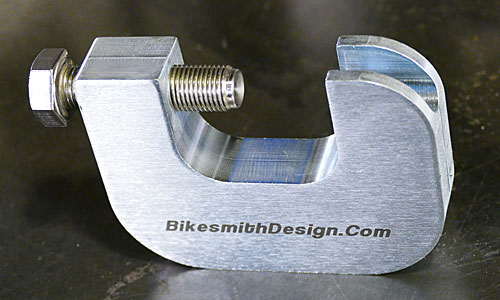
emailing about cotter presses, please include "Cotter Press" in your subject line. Cotters installed with a press are much less likely to loosen up than those intalled by just tapping with a hammer and tightening the nut on the cotter threads. Removing with a press is much less likely to damage your cranks, or your bearings, than using a hammer. And you are far more likely to be able to reuse your existing cotters. (See Caveat below right.) New "Deep Throat" design allows you to orient the press in line with the crank arm for removal of cotters. Holding the tool inline with the arm allows the cupped bolt end to center itself on the center of the threaded stem of the cotter.Presses are
machined from oil finished, cold rolled 1018
steel. The stainless steel bolts are 1/2" x 20tpi for durability and so
either 3/4" or 19mm wrenches will work on the hex. |
If you are working on old English bikes, or cheap Big Box
store
bikes like Magnas, for $20 you may also be
interested in this
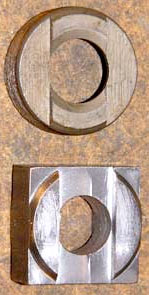
Fixed Cup Tool. |
| When they are used every day, such as in some "Community" bike shops, the threads in the body can eventually wear out. Out of about 1,800 sold, I've heard of 6 instances of this happening. I looked into having the bodies made of 4140 steel. But the price would double, putting the presses out of reach for most home mechanics. | |
|
Removal
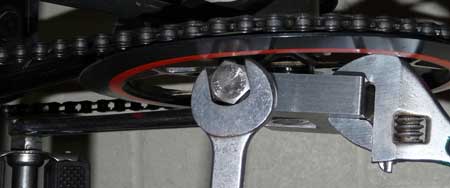
For the cupped bolt to properly center itself on the threaded stem you
need to have the press body inline (or nearly so.) with the crankarm. ![]() Grease the cupped end of the bolt. Use of a 2nd wrench (Also 3/4" or 19mm) to hold the body can be helpful. |
Multi-Task
Tool
Most presses are used to install and remove bicycle crank
cotters. But customers (Usually Australians for some reason.)
have
purchased them for other purposes.
|
|
Installation
Installed properly,
there should be enough friction between the spindle
and bore to eliminate movement. The cotter will only be loaded in
compression, evenly across the face, and be easily removed.
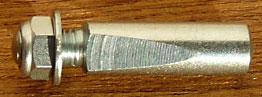
Without this friction, the only thing resisting movement will be the relatively soft cotter, loaded in shear. When you see grooves across the cotter face, either the cotter wasn't tight enough, there was grease between the spindle and the bore or both. 1. Avoid chromed spindles. Sandblasting or sandpaper can help if you don't have a choice. 2. Make sure spindle and spindle bore are clean and dry. 3. Use anti-seize or grease on cotter. 4. Install FIRMLY
with a cotter press. As you tighten the
cotter, the wrench will move smoothly and with gradually increasing
resistance, till you get to a point where force required to move the
wrench suddenly increases. That's when you stop. For installation, the
orientation of the press body to the crank arm doesn't matter. When installing cotters, I suggest holding your wrench with your thumb near the bolt head, to keep you from applying too much leverage. This tool is so powerful that one fellow mushroomed the fat end of a cotter. Years after tourists had alloy cotterless cranks, most professional racers were still using cottered cranks. If they were not reliable, when installed properly, this would not have been the case. |
Doesn't
work on Williams B100
Or similar cranks where the chainring or spider is less than
7/16"(11mm) from the center of the cotter.Contrary to a posting on the Classic Rendezvous list, the press works just fine on the Williams C1200. Perhaps the poster didn't know which Williams crank he has. |
|
First
of Many Testimonials
Mark,As you predicted, press arrived Wed. I immediately popped the cotters out of an old Dunelt. Very nice work. However, I suggest you should add a warning to those of us used to attempting removal by C-clamp and bushing (or socket), then heat when that doesn't work! Warning might read: "Beware, works so effortlessly, that you may accomplish removal so easily and quickly, that device may drop and injure toes if you are not careful!" Thanks, Clyde, New Orleans LA |
|
|
Caveat
With a press, nearly every cotter with a 7mm stem and most with 6mm
stems can be removed in one piece. Unless
someone has bent the threaded section, by trying a hammer first.
However, there are a few where the threaded stem will
crush without budging the cotter. I believe those have suffered galvanic corrosion (or some such). Your odds of a successful removal are much better if the cotter was installed properly. |